
1 Magnetic Force
Magnetic Force
- Static charges produce an electric field while current or moving charges produce magnetic field (B).
- Magnetic field of several sources is the vector addition of magnetic field of each individual source.
Lorentz Force
- Consider a point-charge q moving in the presence of both electric and magnetic fields.
Let
q − Point charge
v − Velocity of point charge
t − Time
r − Distance
B (r) − Magnetic field
E (r) − Electric field
∴ Force on the charge, 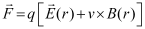 = Felectric + Fmagnetic
This force is called Lorentz force.
- Force due to magnetic field depends onq, v, B. Force on negative charge is opposite to that of positive charge.
- Magnetic force is a vector product of velocity (v) and magnetic field (B). It vanishes, ifv and B are parallel or anti-parallel.
- Magnetic force is zero, if charge is not moving.
- Unit of magnetic field (B) is tesla (T).
Magnetic force on a current carrying conductor:
A straight rod carrying current is considered.
Let
A − Cross-sectional area of the rod
l − Length of the rod
n − Number density of mobile charge carriers
I − Current in the rod
vd − Average drift velocity of mobile charge carrier
B − External magnetic field
Force on the carriers,
F = (nAl) qvd × B
Since current density, j = nqvd
∴ F = [(nqvd)Al] × B
F = [jAl] × B
F = I l × B
Where,
l is the vector magnitude of length of the rod
- For a wire of arbitrary shape,
